The Circle, Part 1: Setting the Stage
This is part 1 of a multi-part series. Read part 2 here.
The 1877 Letter
In 1877, a Norwegian immigrant writing from San Francisco referenced “the movement”—a fifteen-year operation that had begun in Harlem in 1862 and was, by his account, nearing completion. He called it “the Circle.” This letter remained in archives for nearly 150 years before I encountered it.
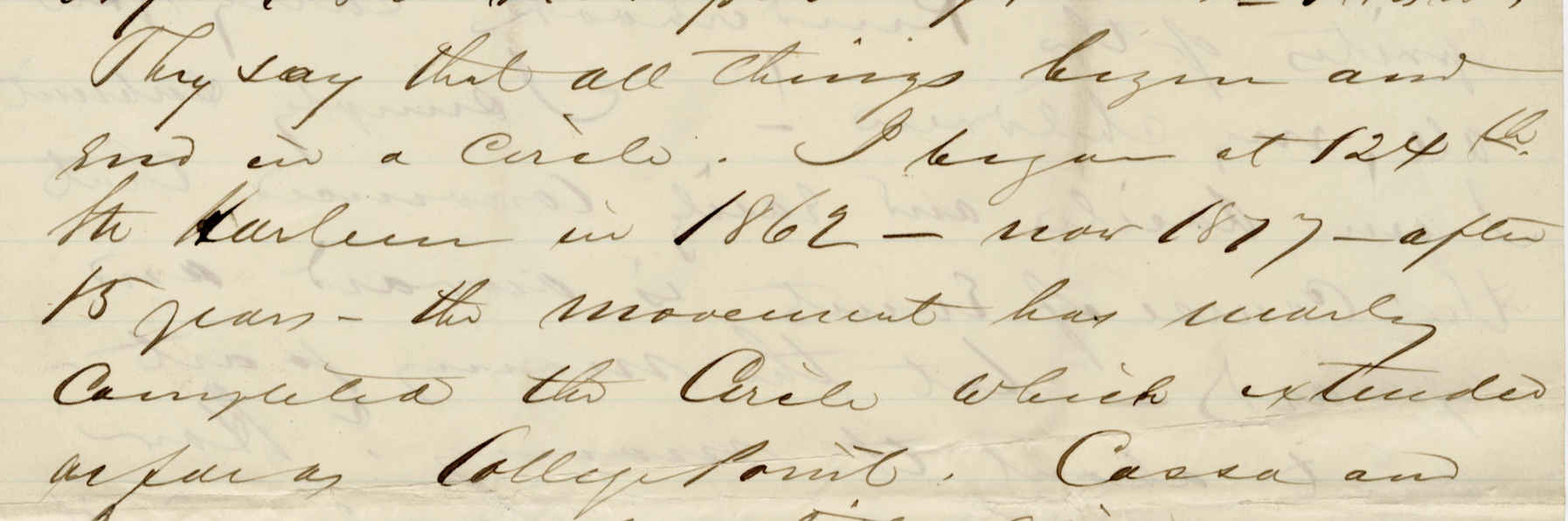
Excerpt from a James D. Reymert letter, February 1877. Norwegian-American historical Association.
“They say that all things begin and end in a Circle. I began at 124th in Harlem in 1862 - now 1877 - after 15 years - the movement has nearly completed the Circle which extends as far as College Point.”
Notice that the word “Circle” is capitalized both times. To understand its significance, we must first establish context for the Knights of the Golden Circle.
What Was the KGC?
The Knights of the Golden Circle (KGC) were a paramilitary secret society active before and during the American Civil War. The organization took its name from its stated objective: the creation of a “Golden Circle”—a sphere of influence with a 2,400-mile diameter centered on Havana, Cuba, encompassing the Southern United States, Mexico (proposed to be divided into 25 new slave states), Central America, northern South America, and most of the Caribbean islands including Cuba, Haiti, and the Dominican Republic. The envisioned empire would function as an agricultural powerhouse producing cotton, tobacco, cacao, coffee, and other commodities on slave labor, with goods flowing through Gulf ports—Pensacola, various Texas harbors—and up the Mississippi River for continental distribution.
This is not a conspiracy theory but a documented conspiracy. President Lincoln took the threat seriously enough to dispatch his personal secretary, John Hay, to investigate KGC successor organizations. Joseph Holt’s 1864 official report to Secretary of War Edwin Stanton detailed the Order of American Knights and Sons of Liberty, organizations that evolved from the KGC. Even John Wilkes Booth has been alleged to have been a member, though this claim, like many KGC associations, remains unproven.
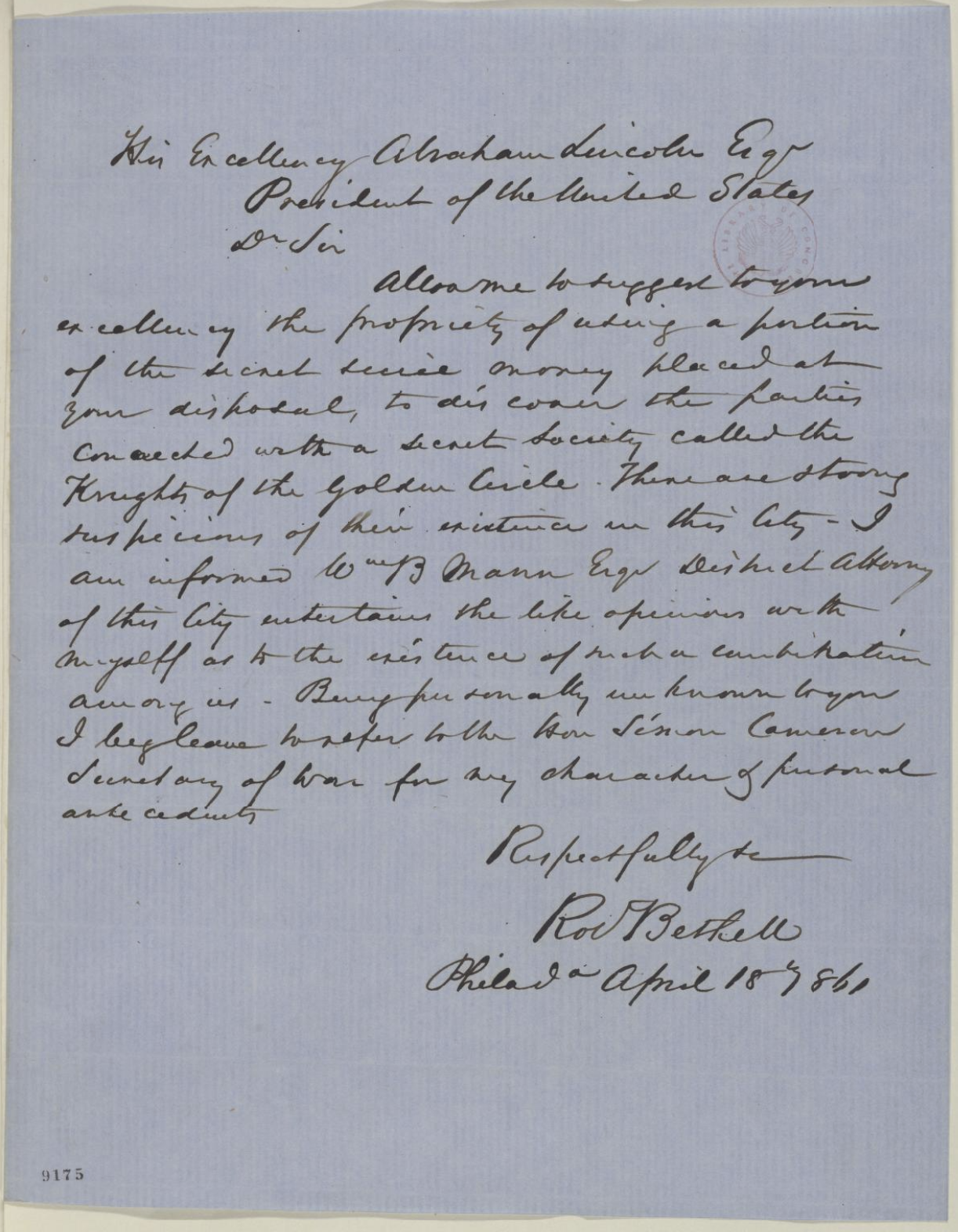
Letter to President Lincoln's office, April 18, 1865—three days after his assassination—requesting funds to investigate Knights of the Golden Circle activity in Philadelphia. Library of Congress
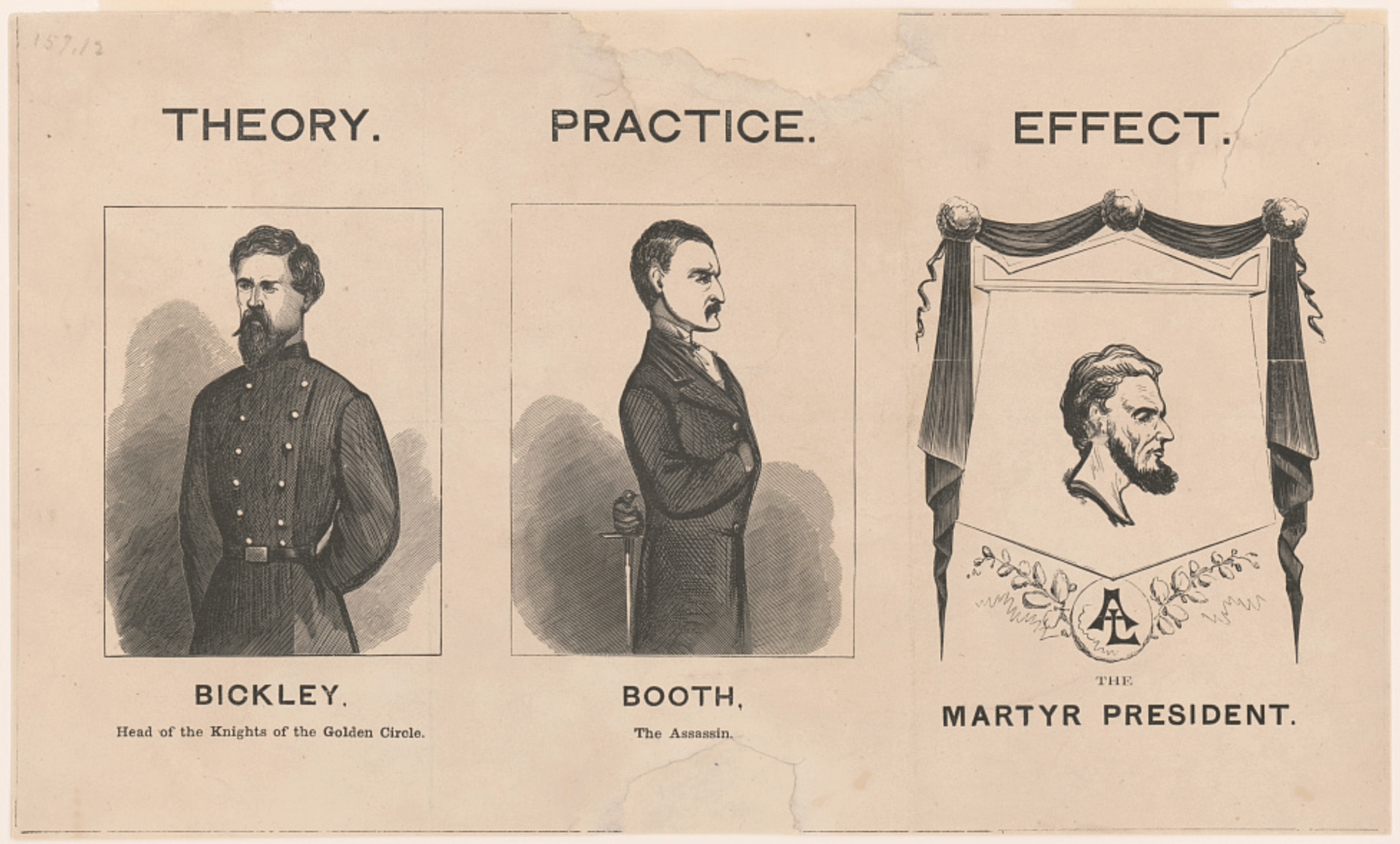
Political cartoon from the Lincoln assassination period depicting George Bickley (KGC founder), John Wilkes Booth, and President Lincoln. Alfred Whital Stern Collection, Library of Congress.
The Power Behind the Conspiracy
The alleged membership roster illustrates the organization’s potential reach into the highest levels of American power. It included men such as:
Howell Cobb: U.S. Secretary of Treasury (1857-1860), U.S. Speaker of the House (1849-1851), Governor of Georgia (1851-1853)
John Floyd: U.S. Secretary of War (1857-1860)
John C. Breckinridge: Vice President of the United States (1857-1861)
Caleb Cushing: U.S. Attorney General (1853-1857), Associate Justice of Massachusetts Supreme Judicial Court (1852-1853), U.S. Congressman (1835-1843), Commissioner to China (1843-1845), Brigadier General in Mexican-American War.
These associations are allegations made by contemporary political opponents or subsequent researchers. Unlike George W.L. Bickley, arrested in 1863 with KGC documents in his possession, none of these men were caught with membership rolls or physical evidence. We are dealing with a Secret Society, one that sustained government investigations could not fully penetrate. The footprints they left behind, however, remain visible.
Whether or not formal KGC membership can be definitively established, individuals connected to the organization occupied positions of extraordinary authority. The Secretary of Treasury controlled monetary policy and federal bonds; the Secretary of War directed military contracts, procurement, and weapons distribution; the Attorney General shaped legal policy and enforcement. Collectively, they possessed the institutional capability to influence vast sectors of the American economy and government apparatus. Moreover, each of these men maintained private business interests and partnerships outside civil service—interests that often aligned with stated KGC objectives.
The Financial Question
The KGC’s ambitions extended beyond political conquest to practical logistics. A slave empire spanning thousands of miles would require substantial capital—for land acquisition, infrastructure, military operations, and the establishment of new governments. According to period accounts and later investigations, the organization allegedly accumulated significant financial reserves, with rumors persisting of hidden caches intended to fund a second attempt at Southern independence after the Civil War’s end. Whether these treasure stories represent actual deposits, wartime propaganda, or post-war mythology remains debated. What is documented, however, is that the organization attracted wealthy planters, merchants, and politically connected individuals who possessed both the resources and motivation to fund such an enterprise. The question is not whether the KGC had ambitions requiring enormous capital—the historical record confirms that—but whether they successfully accumulated and concealed such resources, and if so, where those assets might have been placed.
This financial dimension adds another layer to the 1877 letter’s significance. A “movement” that began in 1862 and was “nearly complete” fifteen years later suggests not a failed insurrection but an ongoing operation that survived the Confederacy’s defeat. What would such an operation require? Resources. Infrastructure. Trusted partners around the world. And perhaps most critically—capital stored safely beyond federal reach.
What Follows
This series will examine the relationship between Caleb Cushing and a lesser-known figure: James DeNoon Reymert, the Norwegian immigrant who wrote the 1877 letter. I propose that both men warrant investigation as potential KGC members or associates. While I lack direct documentary evidence—no membership certificates, no explicit self-identification—I present circumstantial evidence and pattern analysis that, taken together, suggest connections warranting serious consideration. We will be examining documented actions, associations, timelines, and terminology that align with known KGC operations and objectives.
Thousands of pages have been written by various authors, government investigators, and concerned citizens about the KGC, much of it easily accessible online. I introduced the KGC here only as necessary context for understanding what follows: an examination of Reymert’s and Cushing’s relationship, which I’ll begin in Part II.
Join the Discussion
What are your thoughts on this research? Share in the comments below, or join deeper conversations with fellow researchers in the Discord community: https://discord.gg/Zmm4rfsc
Notes
[1] Reymert, James D. Letter from San Francisco, February 1877. Norwegian-American Historical Association Digital Collections. https://www.norwegianamericanhistory.org/digital-collections/items/show/477
[2] Holt, Joseph. Report of the Judge Advocate General on “The Order of American Knights,” alias “The Sons of Liberty.” A Western Conspiracy in aid of the Southern Rebellion. Washington, DC: Union Congressional Committee, 1864. https://archive.org/details/reportofjudgeadv00unit.
[3] Bethell, Robert. Letter to President Abraham Lincoln (or his office), Philadelphia, April 18, 1865. Library of Congress, Manuscript Division. https://www.loc.gov/item/mal0917500/
[4] "Theory. Practice. Effect: Bickley, Head of the Knights of the Golden Circle. Booth, The Assassin. The Martyr, President." Alfred Whital Stern Collection of Lincolniana, Library of Congress. https://www.loc.gov/item/2020771056/